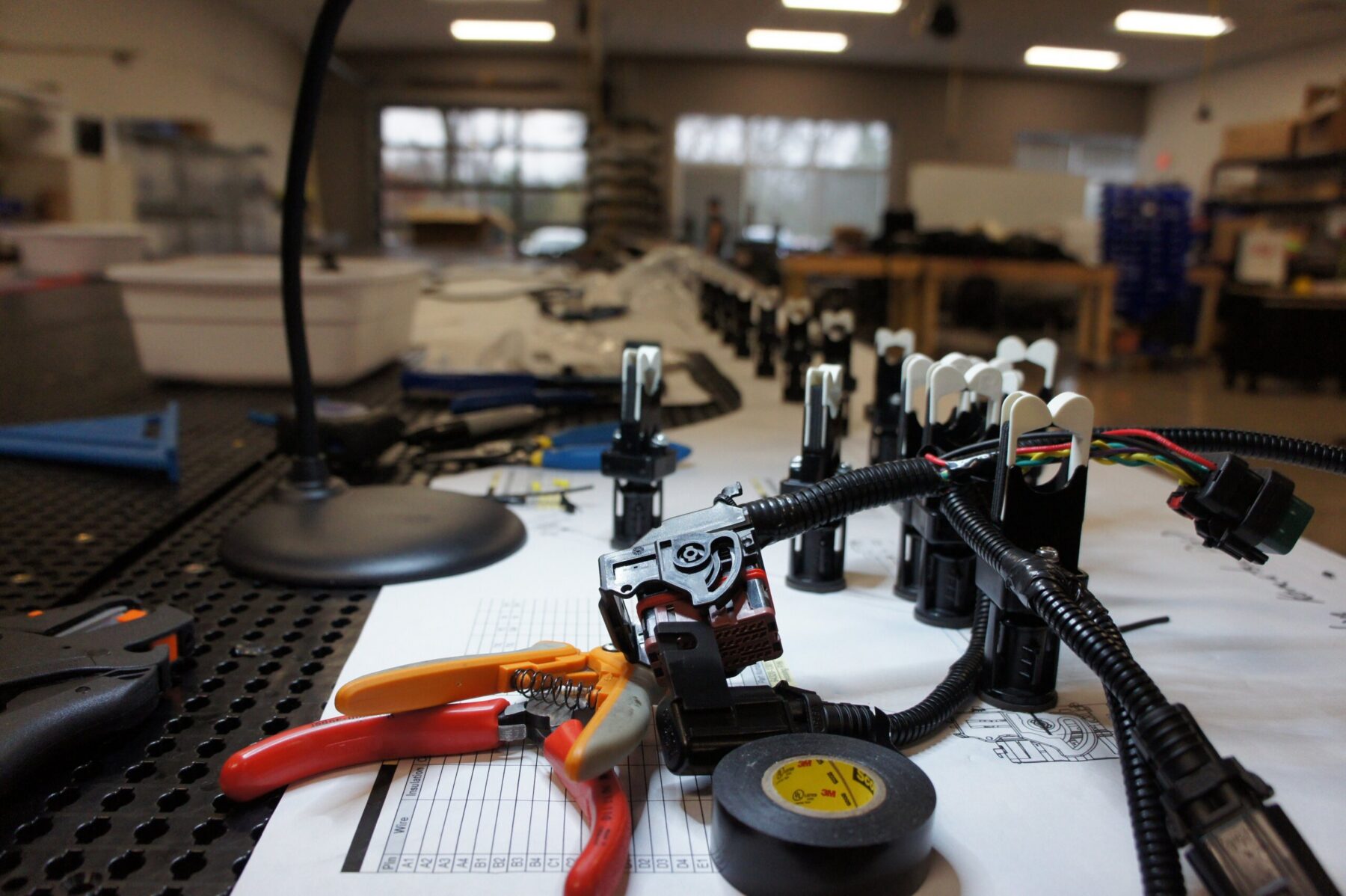
Modern product development moves fast. Compressed timelines, complex electrical systems, and unforgiving production schedules leave little room for the kind of late-stage rework that can derail a launch. For OEMs building off-highway equipment, industrial machinery, and other complex assemblies, the cost of discovering a manufacturability problem after tooling is committed is measured not just in dollars but in months of lost market position.
Design for manufacturability (DFM) is the discipline that keeps those problems from happening in the first place. When applied to wire harnesses specifically, components that touch nearly every system in a modern machine, DFM principles can mean the difference between a harness that drops smoothly into assembly and one that fights the technician at every connector. Prototyping is where DFM stops being theoretical. A physical harness prototype isn’t just a functional test article; it’s a validation tool that proves whether a design can actually be built, assembled, and scaled to production volume without redesign.
Understanding DFM for Wire Harnesses
DFM principles ensure that a wire harness is easy to assemble, fits correctly the first time, and can scale from a handful of prototype units to full production without major design changes. A harness that looks clean in CAD can still create real problems on the assembly floor: wires that won’t route around a bracket, connectors that can’t be reached once a panel is installed, or service loops that don’t account for vibration and movement.
The factors that drive harness manufacturability are concrete and well understood:
- Bend radius: wires and bundles need enough room to curve without stressing insulation or conductors.
- Connector spacing: connectors packed too tightly can’t be mated by hand, especially with gloves on.
- Routing clearance: harnesses need space to avoid sharp edges, heat sources, and moving parts.
- Retention and strain relief: clips, clamps, and strain relief features keep the harness in place and protect terminations from fatigue.
- Service access: the harness has to be installable and serviceable, not just designable.
When these factors are considered during design rather than discovered during assembly, the harness becomes a manufacturable component rather than a manufacturing problem.
Manufacturability also extends beyond physical routing. Terminal selection, splice design, crimp accessibility, testing requirements, and production tooling considerations all influence whether a harness can be built efficiently and consistently at production volumes. Advanced manufacturing processes such as ultrasonic splice welding provide stronger, more consistent electrical connections while reducing variability compared to traditional mechanical splice methods.
Role of Prototyping in DFM Validation
CAD models and digital mockups catch a lot, but they don’t catch everything. A wire harness only fully reveals itself when a technician actually picks it up and tries to install it. That’s why physical prototyping is a critical layer of DFM validation, testing real-world assembly and fit, not just form and function.
Early-stage harness prototypes surface design bottlenecks that won’t appear on a screen: routing conflicts where two bundles want to occupy the same space, connectors that are difficult to reach once neighboring components are in place, or bend points that look fine in 3D but kink in reality. The tactile feedback of working with a physical sample is irreplaceable. Engineers and assembly technicians can feel connector engagement, test whether mounting points line up, and verify that the harness sits naturally along its intended routing path. This is where manufacturability gets proven, or disproven, before the design is locked.
Identifying and Fixing Manufacturing Risks Early
The value of prototyping shows up most clearly in the problems it catches before they become expensive. Common manufacturing risks that prototype builds reveal include:
- Harness abrasion: a routing path that looks safe in CAD but rubs against a bracket edge under real-world vibration.
- Incorrect lengths: a wire run that’s a few inches short once the harness is actually installed around obstacles, not in a straight line.
- Connector misalignment: mating connectors that don’t quite reach each other or sit at awkward angles that stress the terminals.
- Routing conflicts: interference with adjacent components, heat sources, or service access paths that weren’t fully modeled.
Catching any one of these issues during prototyping is far less expensive than catching it in pilot production. Late-stage design changes can mean retooling, scrapped inventory, requalifying suppliers, and pushing back launch dates. A prototype that exposes the problem early lets the design team adjust before any of those costs are incurred.
Reducing Assembly Time and Cost Through DFM Prototypes
Beyond risk reduction, DFM prototyping creates opportunities to actively improve the design for production. By working with a physical harness, engineers can identify ways to:
- Simplify routing paths: straighter, shorter runs that reduce material cost and installation time.
- Reduce part count or connector types: consolidating similar connectors or eliminating redundant splices reduces both BOM complexity and assembly steps.
- Consolidate functions into subassemblies: building modular sections that drop in as a unit rather than being assembled in place.
These changes compound in production. Every connector eliminated, every routing path simplified, and every subassembly consolidated reduces variability on the assembly line, which matters especially for manual or semi-automated assembly processes where technician judgment and dexterity are part of the process. A harness designed with manufacturability in mind builds the same way every time, regardless of who’s building it.
From Prototype to Production-Ready Design
One of the most common challenges in wire harness development occurs when a prototype works successfully, but the design cannot be efficiently scaled to production. Design decisions that seem acceptable for a small prototype build may create excessive labor, inconsistent quality, or sourcing challenges at higher volumes.
By applying DFM principles during prototyping, engineering teams can evaluate production readiness early. Considerations that smooth the transition from prototype validation to full-scale manufacturing include:
- Standardizing connector families across the design
- Reducing the number of unique components
- Improving testability with designed-in test points and clear pass/fail criteria
- Simplifying assembly operations to reduce labor and variability
Addressing these early means the design that passes prototype validation is the same design that builds cleanly at volume, rather than one that has to be reworked the moment production ramps.
The Role of Engineering Partners in DFM Success
Not every product team has the in-house bandwidth or specialized capability to run a thorough DFM and prototyping process. Tight production deadlines, complex designs, and limited internal resources are common reasons to bring in an external engineering partner, particularly when harness complexity exceeds what a general electrical team handles regularly.
A partner like RFA Engineering supports manufacturability through:
Rapid prototyping and low-volume production support
Production-caliber harness prototypes and low-volume builds produced using the same processes, tooling concepts, and quality standards intended for full-scale manufacturing. This allows engineering teams to validate not only fit and function, but also assembly methods, test procedures, and manufacturing repeatability.
In-house manufacturing capabilities
Harness manufacturing that combines automation and process control to build consistent, production-ready assemblies:
- Wire cutting and stripping automation
- Crimp quality validation
- Ultrasonic splice welding
- Connector and terminal selection
- Labeling and identification systems
- Continuity and electrical testing
- Production fixture and board development
Hands-on fit-up and test analysis
Physical evaluation of how the harness installs, routes, and performs in its intended application, including continuity checks and full functional testing.
Recommendations to streamline assembly and sourcing
Design refinements that reduce part count, simplify routing, and identify alternative connectors or components that improve both manufacturability and supply chain resilience.
The right partner doesn’t just build prototypes. They bring an engineering perspective that helps the design team see manufacturability issues before they become production issues.
Prototyping as a Strategic DFM Investment
Wire harness prototypes are too often treated as a functional checkpoint, a way to confirm that the electrical design works. That framing undersells their real value. A well-executed prototype program is a powerful DFM tool, one that reduces costs, shortens development cycles, and improves the quality of the final product before it ever reaches production.
The companies that get the most from prototyping are the ones that treat it as a strategic investment in manufacturability, not a box to check before tooling. Whether you need wire harness prototyping, design for manufacturability support, production testing, or low-volume manufacturing assistance, RFA Engineering helps OEMs identify risks early and develop production-ready harness solutions that support successful product launches. If you’re working on a harness program where manufacturability matters as much as function, reach out to discuss your project.